
Contents
When is which nutrient used, and why? If you feed your cannabis plants yourself at home, the right timing decides yield, aroma and plant health. Our BudXXL feeding schedule takes the guesswork out of it: a clear plan from seedling to harvest. In this guide we explain step by step what each product does, when to give it and how to mix your nutrient solution from it in just a few minutes.
New to growing? First get the big overview in our beginner's guide to cannabis growing. This article is the deep dive on feeding.
How to read the feeding schedule
- Unit: every number stands for ml per litre of watering water. "Bloom 4-6" means 4 to 6 ml per litre of water.
- Order: always add products to the water one after another, stirring well each time, never pour concentrates together.
- pH last: only once all nutrients are in the water, set the pH value (with a pH down or pH up solution).
- A range means leeway: where a range is given (e.g. 3 to 5 ml), start at the lower end and only increase if the plant tolerates more.
The three phases at a glance
- Vegetative / veg (Veg 1 to 2): the plant builds leaf mass and structure. The base is Grow, supported by Root and Vita+.
- Flowering (Bloom 1 to 8): the plant puts its energy into the flowers. Now Bloom takes over as the base, and from the middle Candy joins as a flower booster.
- Flush week (Bloom 9): clear water only. This is common practice; a proven taste benefit is lacking, but a short flush does no harm.
The BudXXL products: when and what for
- vegetative nutrient
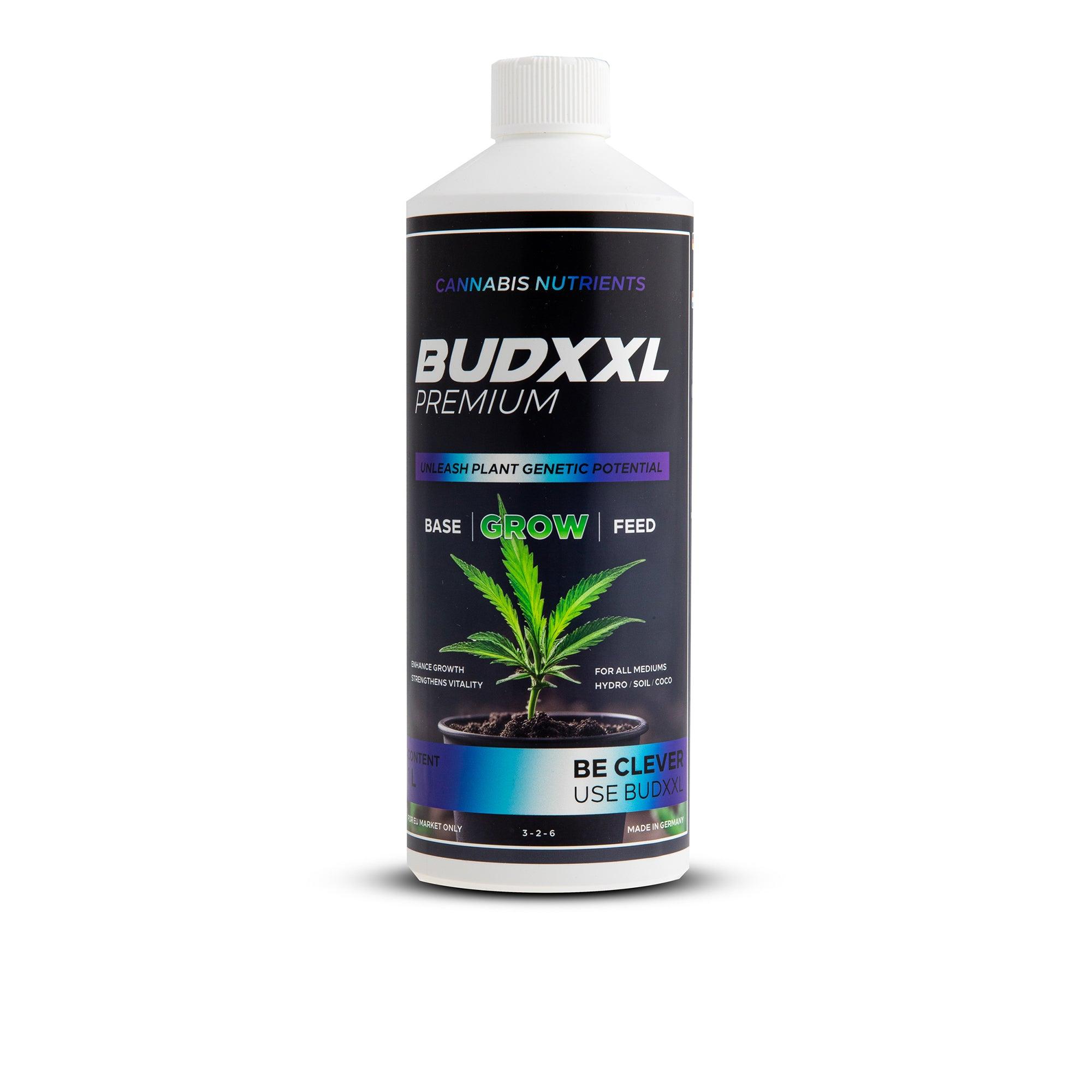
Grow
Complete base nutrient with nitrogen, phosphorus, potassium and trace elements for the vegetative phase. The building material for strong, deep-green foliage.
3-5 ml/L · Veg 1-2 - flowering nutrient
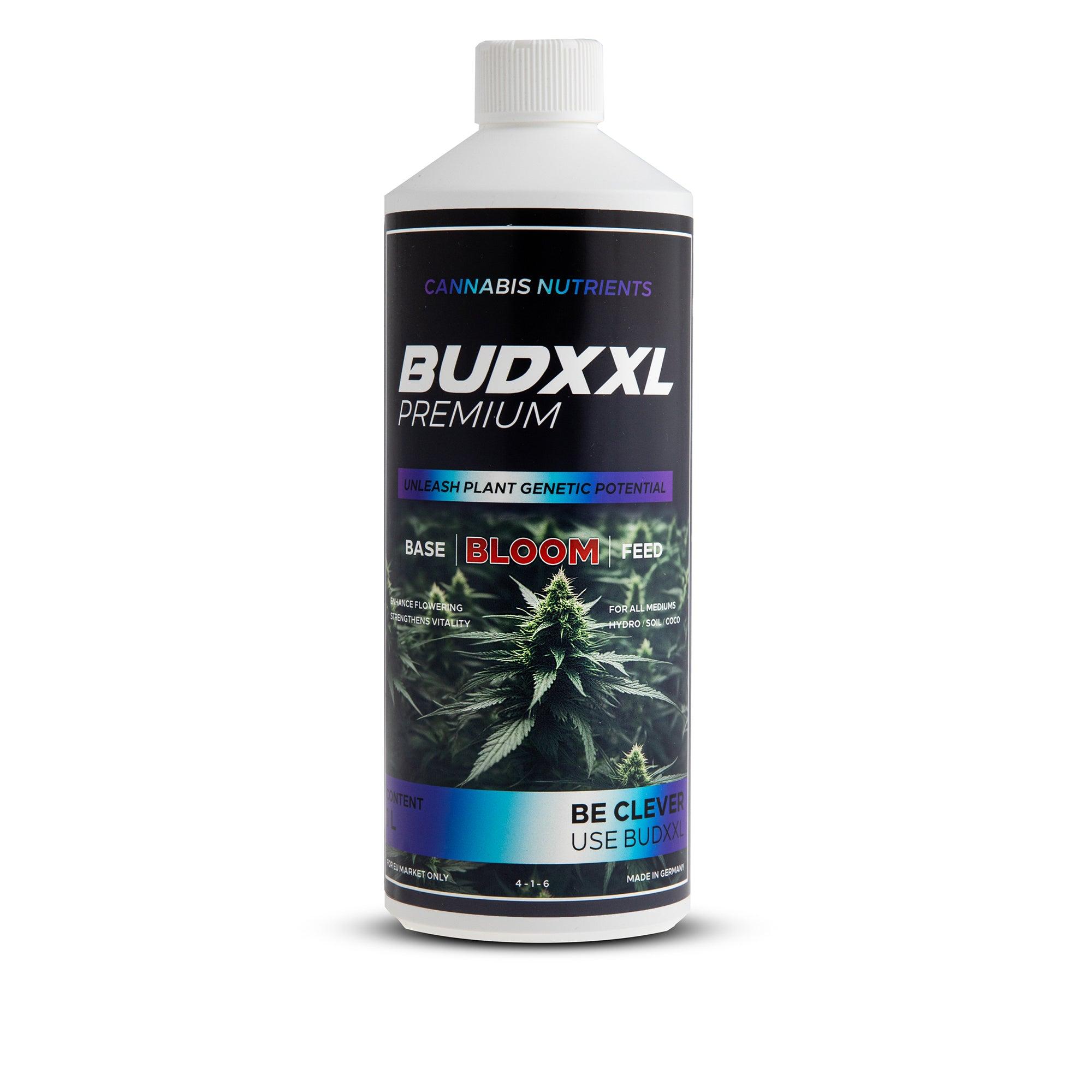
Bloom
Potassium-forward base nutrient with trace elements, tuned to flowering. Accompanies the plant through the entire flowering phase.
4-6 ml/L · Bloom 1-8 - calcium and magnesium
CalMag
Supplements calcium and magnesium and prevents deficiencies (yellowing between the leaf veins, brown spots). Especially important with coco and soft water.
1 ml/L · Veg 1 to Bloom 8 - root stimulator
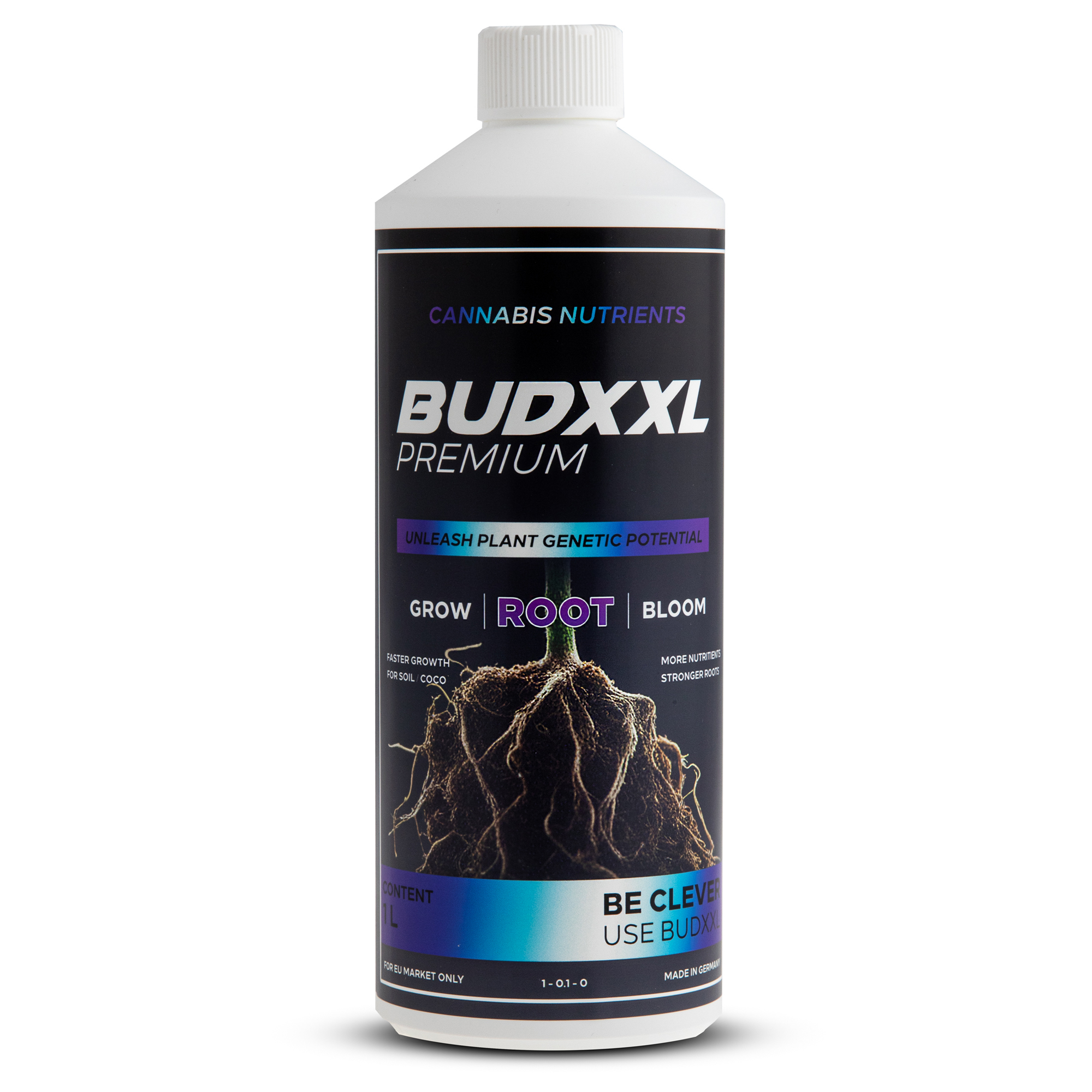
Root
Promotes a strong root system in the start phase. Strong roots mean better nutrient uptake and a more robust plant.
1 ml/L · Veg 1 to Bloom 2 - flower and PK booster
Candy
Not a sugar additive but an extra portion of phosphorus, potassium and sulphur for plump, dense and aromatic flowers. Increased towards late flowering.
0.5 → 1 → 1.5 ml/L · from Bloom 3 - plant strengthening
Vita+
Natural biostimulant from brown algae extract. Strengthens the plant, reduces stress and promotes vigorous growth.
2 ml/L to start, then 1 ml/L every 2 weeks
The complete schedule: week by week
All values in ml per litre of water. A dash means: this product is not given that week.
| Product | Vegetative | Flowering | Flush week | ||||||||
|---|---|---|---|---|---|---|---|---|---|---|---|
| Week | V1 | V2 | B1 | B2 | B3 | B4 | B5 | B6 | B7 | B8 | B9 |
| Grow | 3-5 | 3-5 | – | – | – | – | – | – | – | – | – |
| Bloom | – | – | 4-6 | 4-6 | 4-6 | 4-6 | 4-6 | 4-6 | 4-6 | 4-6 | – |
| CalMag | 1 | 1 | 1 | 1 | 1 | 1 | 1 | 1 | 1 | 1 | – |
| Root | 1 | 1 | 1 | 1 | – | – | – | – | – | – | – |
| Candy | – | – | – | – | 0.5 | 0.5 | 1 | 1 | 1.5 | 1.5 | – |
| Vita+ | 2 | – | 1 | – | 1 | – | 1 | – | 1 | – | – |
| Bloom 9 (B9) is the flush week: clear water only, no nutrients. | |||||||||||
The week figures are a framework. Depending on strain and setup, flowering can be shorter or longer. Go by the state of the plant, not rigidly by the calendar.
How much do I need? Consumption per plant and cycle
| Product | 1 plant | 2 plants | 3 plants |
|---|---|---|---|
| Grow | ~40 ml | ~80 ml | ~120 ml |
| Bloom | ~200 ml | ~400 ml | ~600 ml |
| CalMag | ~50 ml | ~100 ml | ~150 ml |
| Root | ~20 ml | ~40 ml | ~60 ml |
| Candy | ~30 ml | ~60 ml | ~90 ml |
| Vita+ | ~30 ml | ~60 ml | ~90 ml |
Bloom is the main consumer (longest phase). You only need Grow, Root, Candy and Vita+ in small amounts. The easiest way is to let the nutrient calculator work out exactly how much your grow needs — with one-click add to cart.
Step by step: mixing the nutrient solution correctly
- Prepare the water: fill a container with the required amount of water (room temperature, approx. 18 to 22 °C).
- CalMag first: with soft or reverse-osmosis water, CalMag goes in first and is stirred in.
- Base nutrient: depending on the phase, add Grow or Bloom in the stated amount and stir.
- Additives: add Root, Candy and Vita+ according to the week, always individually and while stirring.
- Set pH: finally measure the pH value and bring it to your medium's target range with pH- or pH+.
- Water: use freshly mixed. Do not leave leftovers standing for days.
Rule of thumb for the order: "CalMag, then base, then booster, then pH". Never mix several concentrates directly with each other, always into the water first.
Across media: what to watch depending on the substrate
- Soil: buffers nutrients best. It is no problem if you water with plain water in between — just do not double up afterwards, simply continue with the schedule.
- Coco: behaves almost like hydro, best to feed lightly with every watering. CalMag is especially important here.
- Hydro and systems: reacts most directly. Monitor EC and pH closely and fine-tune the concentration accordingly.
For the advanced: EC, pH, deficiencies and flush
Expand the expert section
pH targets by medium
- Soil: pH 6.2 to 6.8
- Coco: pH 5.8 to 6.2
- Hydro: pH 5.5 to 6.0
In these ranges most nutrients are optimally available. If the pH is permanently off, deficiencies arise despite sufficient feeding ("lockout").
EC as a check
Your EC follows from the dosing above (ml per litre). You do not need to hit a fixed target EC. Measure it as a check: it rises from the vegetative to the full-flower phase and drops to the value of your plain water during the flush week. A rough upper limit is around 3 mS/cm, above which yield can suffer.
Recognise deficiency signs early
- Nitrogen: lower, older leaves yellow evenly. Partly normal in flowering, in veg a sign of too little Grow.
- Magnesium: yellow between the leaf veins on middle/lower leaves. Raise CalMag.
- Calcium: brown spots and crippled new growth at the tip. Raise CalMag, check pH.
- Potassium: burnt, brown leaf edges, often in full flower. Keep an eye on Candy/Bloom.
- Excess ("nutrient burn"): glossy, downward-clawed, burnt leaf tips. Reduce the dosage.
Flushing before harvest
In the last week (Bloom 9) you give only clear, pH-adjusted water. Whether flushing actually improves taste is not scientifically established (see sources). A short flush (max. 1 to 2 weeks) does no harm.
Frequently asked questions
Do I have to use all the products?
Grow, Bloom and CalMag form the basic framework. Root, Candy and Vita+ get the most out of it. For the best results we recommend the complete schedule.
What if my flowering lasts longer than 8 weeks?
No problem: simply continue Bloom (and in late flowering Candy) until about a week before harvest, then add the flush week.
Feed every watering?
In coco and hydro usually yes. In soil it is no problem if you skip the nutrients for a round — do not give a double dose afterwards, simply continue with the schedule. Watch the plant and the EC value.
Can I use the schedule for other plants?
The products are universal plant nutrients. For other crops the values serve as rough guidance; the demand varies from plant to plant.
Individual advice
Your grow does not quite fit the schedule?
Substrate, pot size and strain differ a little for every plant. Send us your key details in the chat, we will adjust the schedule together.
What comes next
- Cannabis growing for beginners (the big overview, if you are right at the start)
- Measuring pH and EC correctly (so the dosage actually arrives)
- Spotting and fixing nutrient deficiencies (when the plant plays up)
- Soil, coco or hydro? (the right medium for the schedule)
- Harvesting and drying done right (after the flush week)
- CanG: what is allowed? (the legal framework)
All products from the schedule
 BudXXL Grow
 BudXXL Bloom
 BudXXL CalMag
 BudXXL Root
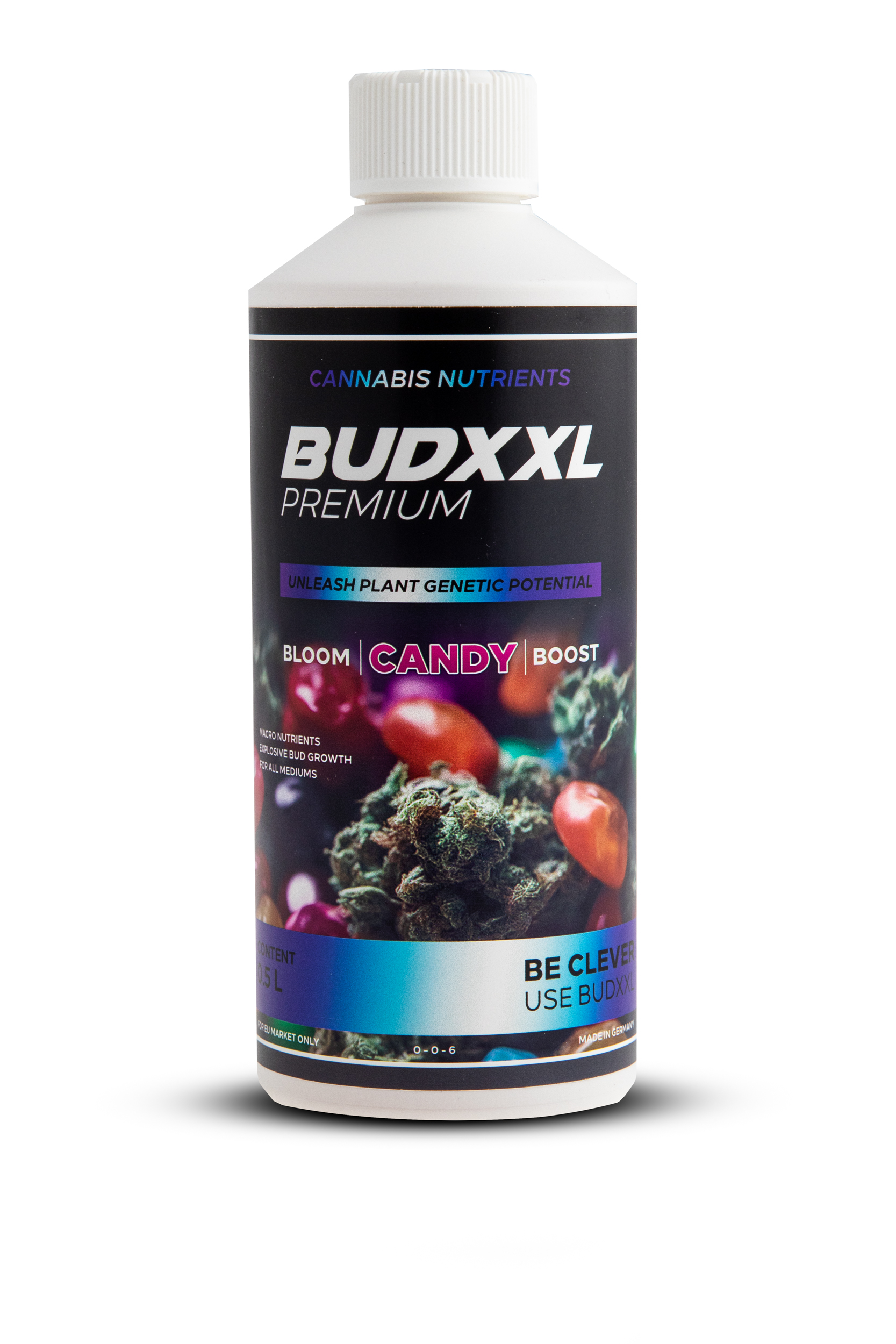 BudXXL Candy
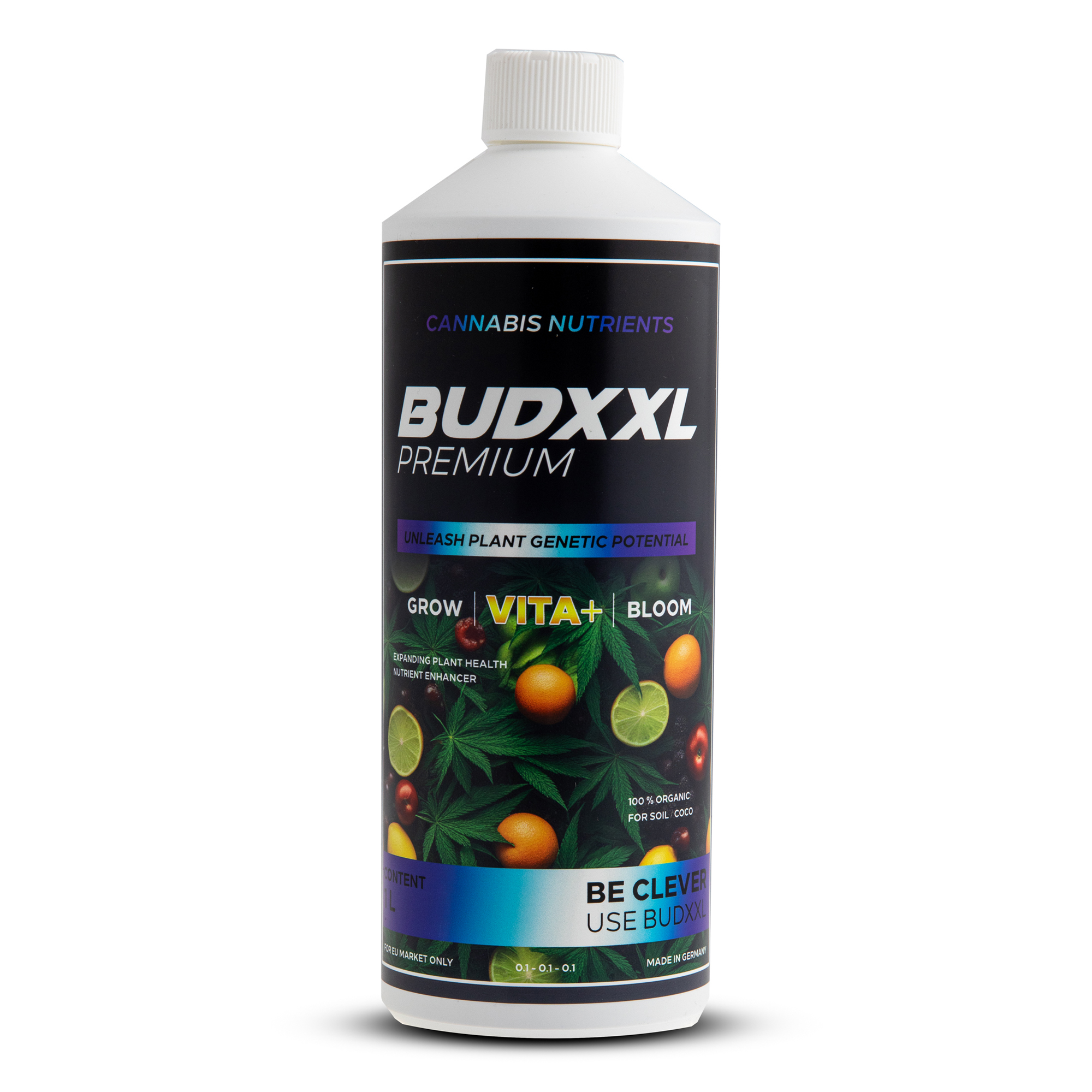 BudXXL Vita+
You set the pH value at the end with a standard pH down or pH up solution.
How much nutrient solution do you really need?
Consumption depends less on the number of plants than on area and the daily amount of water. As a planning figure, a flowering canopy peaks at roughly 10 litres per square metre per day. Early on it is a fraction of that and rises towards full flower.
Important for coco and hydro: part of the solution runs through on purpose (drain-to-waste). Common practice is 10 to 20 percent runoff per irrigation so salts do not build up in the medium. That volume is fully fed, so it counts towards consumption. In hydro systems the reservoir change adds to it, typically once a week.
Nutrient calculator
Your demand in numbers?
The calculator uses exactly these figures: the weekly watering curve per medium, the drainage allowance and the doses from this chart. It gives you the ml per product and picks matching bottle sizes.
Sources
- Saloner, A. & Bernstein, N. (2020): Response of Medical Cannabis to Nitrogen Supply Under Long Photoperiod. Frontiers in Plant Science 11:572293. doi.org/10.3389/fpls.2020.572293
- Optimisation of Nitrogen, Phosphorus, and Potassium for Soilless Production of Cannabis sativa in the Flowering Stage (2021). Frontiers in Plant Science 12:764103. doi.org/10.3389/fpls.2021.764103
- Cockson, P. et al. (2019): Characterization of Nutrient Disorders of Cannabis sativa. Applied Sciences 9(20):4432. doi.org/10.3390/app9204432
- Veazie, P. et al. (2025): Impact of substrate pH and micronutrient fertility rates on Cannabis sativa. Agrosystems, Geosciences & Environment. doi.org/10.1002/agg2.70044
- On flushing: Exploring the Legacy Practice of Flushing … HortScience 60(10):1818 (2025); To flush or not to flush … Industrial Crops and Products (2024).
- On water use: Cannabis Grow Facility Design 101, Part 2: Water Usage. phcppros. phcppros.com — quotes about 1 litre per square foot of flowering canopy per day (roughly 10 L/m²) and 100 to 150 litres of runoff per 1,000 square feet.
- Grabowski, C.: Ways to Calculate Water Use and Transpiration Rates for Indoor Cannabis Cultivation. Greenhouse Grower. greenhousegrower.com
- On runoff in coco: Feeding and watering frequency: Drain-to-waste setups and coir based media. Botanicare. botanicare.com · Watering Coco. Coco for Cannabis. cocoforcannabis.com
- On reservoir changes in hydro: How to water cannabis plants in hydroponic systems. Alchimia. alchimiaweb.com
Legal note: The private cultivation of cannabis has been permitted in Germany for adults within the legally regulated framework since the Consumer Cannabis Act (CanG, 2024) (limited number of plants, personal use, no access for minors). All feeding figures are non-binding guide values; results depend on strain, setup and environment.